 Claudia·18 May 2026·6 min read
What Golf Handicapp Taught Us About Adding AI to Real Products
Most "AI features" added to products in the last couple of years are decoration. A chat box bolted onto a settings page. A "summarise" button nobody asked for. They get a press release and then a graveyard of unused buttons.
The AI Scorecard Scanner we built into Golf Handicapp is the opposite. It removes one specific friction that every player feels at the end of every round, and it has quietly become one of the main reasons people choose the app. We think the lesson behind that is worth writing down, because it applies to almost any small business thinking about where AI might fit in their product.
The Boring Problem Worth Solving
Golf Handicapp is a global handicap tracker. To calculate your handicap accurately, you need to enter your full round. Hole by hole. Eighteen scores, plus the tee, the rating, sometimes the strokes received.
That is a lot of tapping. Especially in the clubhouse, after four hours of golf, with a pencil-marked scorecard in front of you.
Every golf app on the market has the same problem. Almost none of them had solved it. The "innovation" in the category was making the score entry screen marginally prettier.
We did not start with "how can we add AI to this app". We started with "what is the worst thirty seconds of using this app", and the answer was obvious.
What We Actually Built
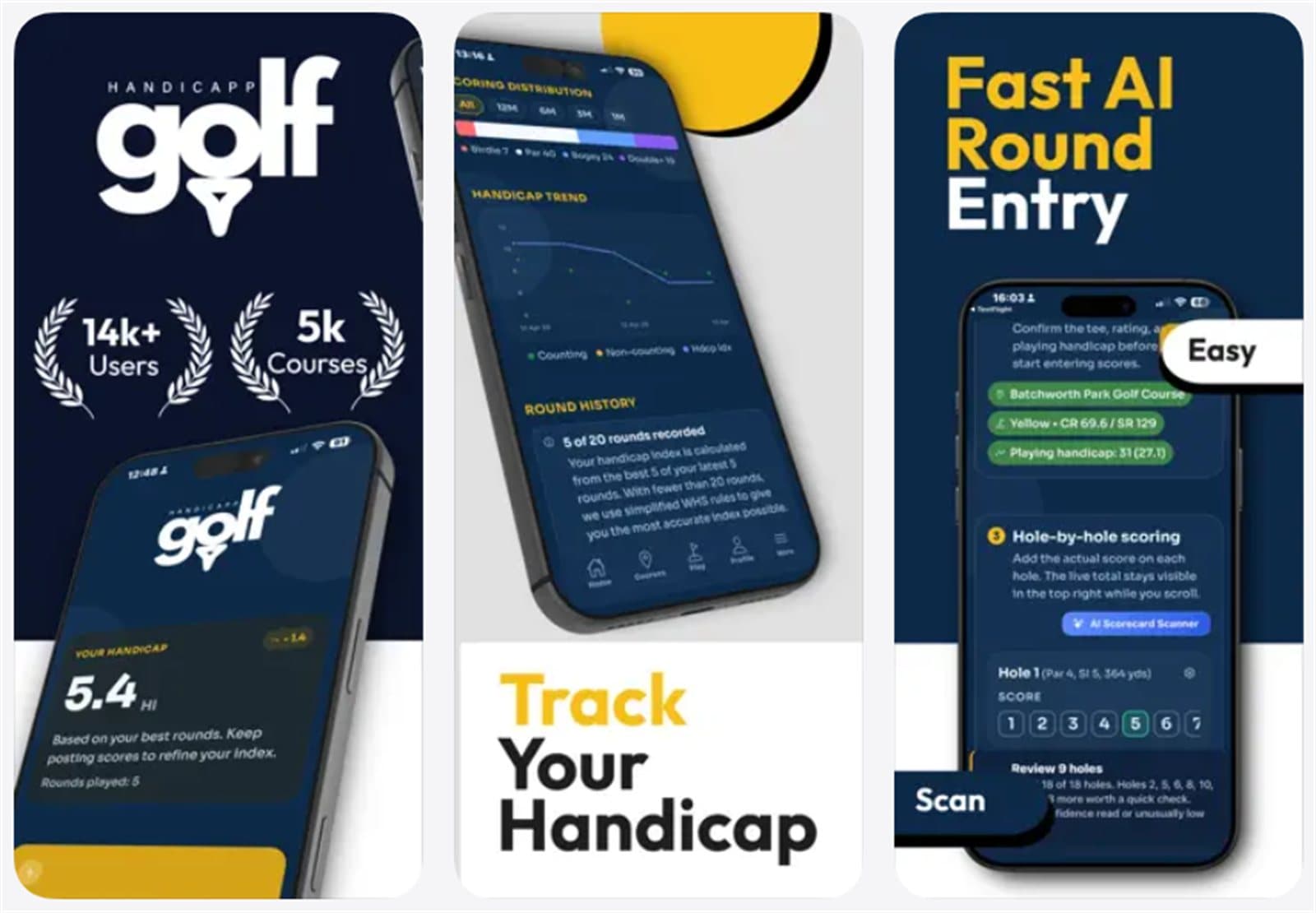
The scanner works like this. You finish the round, open the app, point the camera at the paper scorecard, and a few seconds later the round is in. Holes, scores, stroke index, signatures, the lot.
Under the hood it is not magic. It is OCR, a model that knows what a golf scorecard looks like, validation against the course data we already hold, and a confirmation screen that lets the player fix anything that did not come through cleanly. The "AI" part is doing the bit that would have been impossible five years ago. The rest is good old product work.
The honest split was probably eighty per cent careful product design and twenty per cent model. That ratio matters, and it is one of the things we think small businesses get wrong when they think about adding AI.
The Unsexy Bits That Made It Work
What we spent most of our time on:
- Bad lighting. Clubhouses have terrible light. Half the cards are scanned in a corner with a pint in the way.
- Smudges and crossings-out. Real scorecards have arrows, scribbles, holes the player did not complete.
- Angles. Nobody holds their phone perfectly square. Skew correction matters more than the model.
- Validation. A "7" misread as a "1" is a disaster. The app cross-references against the course's stroke index and par to flag anything that looks off, before it writes to your handicap.
- The confirmation screen. Even the best scanner gets it wrong sometimes. A clean "here is what we read, tap to fix" screen is the difference between a feature that delights and a feature that ruins your score.
None of that is AI. It is the scaffolding around the AI that makes it usable.
Why It Worked Commercially
A round entry that takes thirty seconds instead of three minutes is not a small change. It is the difference between players entering every round and players entering "the good ones". And a handicap is only as accurate as the rounds you log.
When people come to the App Store listing and the first screenshot says "Fast AI Round Entry", they understand immediately what they are getting. It is not a feature buried six screens deep. It is the headline.
We are now at 14,000+ users across 5,000+ courses globally. The scanner is not the only reason for that, but it is consistently mentioned in reviews, and it is the thing that gets brought up first when a player tells a friend.
The Lesson For Small Businesses
If you run a business and you are wondering whether to add AI to your product, our advice is this.
Find the thirty seconds of your product that everyone hates. Not a fancy thing. Not a thing your competitors talk about. The boring, repetitive, frictional bit that every customer goes through and silently dislikes. That is where AI earns its keep.
Then ask whether AI is actually the right tool for that thirty seconds. Sometimes it is. Sometimes a better keyboard, a saved-default, or a simple shortcut would do the job for a hundredth of the cost. Adding AI is a means, not an end.
Build the scaffolding before you build the model. The user-facing experience is mostly product design. Validation, confirmation, error states, fallbacks. The model is one part of the system, not the whole system.
Be honest about what it does. Calling something "AI-powered" without it doing real work is one of the fastest ways to lose trust. If the AI bit is a small slice of the feature, say so. People appreciate the honesty and they trust the rest of the product more.
What We'd Warn Against
A few patterns we see in small business products that almost never pay off:
- Adding a chatbot because everyone else has one. If users do not have a question your product cannot answer through normal navigation, you do not need a chatbot.
- "AI summaries" of content the user wrote themselves. They already know what they wrote.
- Personalised content where the personalisation does not actually change behaviour. "Welcome back, [name]" is not personalisation.
- Calling any algorithm "AI" in marketing copy. It cheapens the parts of your product that genuinely are AI.
If a feature would have been a good idea without the AI label, the AI label makes it better. If it is only interesting because of the label, the feature is the problem.
How We Can Help
We design and build apps, SaaS platforms, and internal tools, and we treat AI the same way we treat any other tool. Useful when it solves a real problem. A waste of money when it does not.
If you have a product, or an idea for one, and you are trying to work out whether AI fits in somewhere, we are happy to talk it through honestly. That is exactly what our AI integration work is about: finding the workflows where AI genuinely helps and building it in securely. Sometimes the answer is yes. Sometimes it is "you do not need AI for that, you need a better workflow". Both answers save you money.
Try our quote generator for a ballpark, or get in touch to talk it through. And if you want to see what we shipped, Golf Handicapp is live on the App Store and Google Play.